

Octopus Lure
49-19-25
From: United States of America | Hawaiian Islands
Curatorial Section: Oceanian


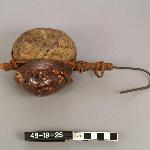
| Object Number | 49-19-25 |
| Current Location | Collections Storage |
| Culture | Hawaiian |
| Provenience | United States of America | Hawaiian Islands |
| Culture Area | Oceania | Polynesia |
| Date Made | 19th century |
| Section | Oceanian |
| Materials | Shell | Stone | Metal | Wood | Plant Fiber | Cowrie Shell |
| Description | An octopus lure (leho he'e or lūhe‘e) consisting of a large metal hook attached to a wooden stick to which a stone sinker and cowrie shell are lashed with plaited coconut fiber cord. In Hawai’i, fishing lures were used alongside nets, sinkers, and fishing lines. For certain species like ʻahi (tuna) or and heʻe (octopus), fishermen preferred artificial lures crafted from hard, reflective materials, particularly thick mother-of-pearl bivalves, where the surface mimicked the flash of prey. This surface-fishing technique, known as pā hi aku, enabled fishing without the use of live bait. Squid and octopus fishing employed the use of a cowrie-shell lure (leho heʻe), operated in deep water through a rhythmic raising and lowering method called lu heʻe. Structurally composed of a wooden stem, stone sinker, cowrie shell, hook, and ti-leaf hackle, these lures relied on balance, movement, and visual attraction to entice their target. |
| Length | 26.5 cm |
| Width | 11 cm |
| Credit Line | Gift of Mrs. T. M. Meryweather, 1949 |
Report problems and issues to digitalmedia@pennmuseum.org.