

Clothing
Bark Cloth
97-120-354
From: United States of America | Hawaiian Islands
Curatorial Section: Oceanian


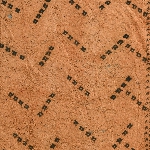

| Native Name | Kapa |
| Object Number | 97-120-354 |
| Current Location | Collections Storage |
| Culture | Hawaiian |
| Provenience | United States of America | Hawaiian Islands |
| Culture Area | Oceania | Polynesia |
| Section | Oceanian |
| Materials | Bark Cloth | Pigment |
| Technique | Beaten |
| Description | A large, yellow, rectangular pa’u (skirt) made of the inner bark of a tree. A square has been removed from a corner of the kapa (Hawaiian bark cloth). The surface decoration consists of blackdesigns in the middle of the cloth, with geometric border patterns along two edges. The designs were created with bamboo stamps (‘ohe kāpala). The garment has been dyed yellow through the use of ʻōhelo (Vaccinium reticulatum or V. calycinum). The tapa was acquired during the United States Exploring Expedition (1838-1842) by Titian R. Peale. The object is identified on Peale's list as a 'Dress [garment] of ‘tapa,’ female attire'. The kapa is referenced in William T. Brigham’s Ka Hana Kapa. An alternate identification was proposed by Adrienne Kaeppler as possibly the top layer of a multi-layered garment. She also noted that there were two different beater marks, which were atypical for Hawaiian bark cloth. Kapa cloth is produced from the inner bark of a tree, typically wauke (paper mulberry), which is cultivated, harvested, and processed through soaking, scraping, fermenting, and repeated beating to form and refine the cloth. Patterned beaters may be used during production to create watermarks that can reflect regional styles or maker affiliations. After drying, the cloth is decorated using natural dyes and bamboo implements. Paʻu are skirts worn by women, typically constructed from bark cloth. They are generally long garments, worn by wrapping a single length of bark cloth multiple times around the body. |
| Length | 240 cm |
| Width | 96 cm |
| Credit Line | Gift of the Academy of Natural Sciences of Philadelphia, 1997 |
| Other Number | L-120-354 - Old Museum Number | 4481 - ANSP Number |
Report problems and issues to digitalmedia@pennmuseum.org.